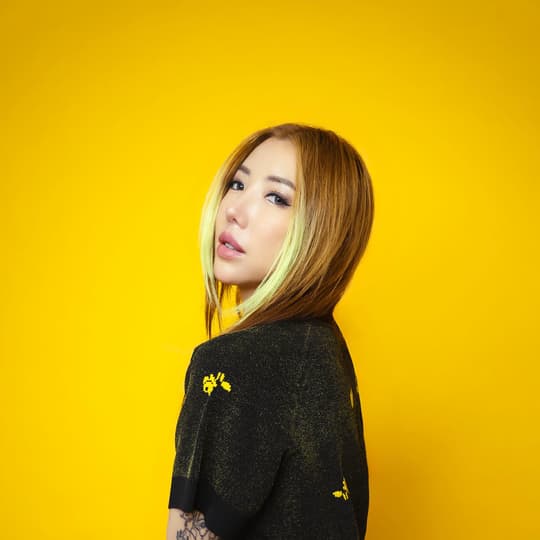
8485 and the Cult of Cultural Relevance
In an internet culture where everything is increasingly personalised, categorised and optimised, 8485 is interested in what happens when we all start trying to keep up with the same conversation. Her latest single, ‘Buzzbands’, takes aim at the strange machinery behind cultural relevance: the hype, social climbing, competition and performance that increasingly blur the line between artistic expression and personal branding.
“I think you know something is culturally relevant when it’s able to reach out and be part of a conversation outside its own little universe,” she tells DMY. “But it’s pretty much impossible to quantify and very easy to fake.”
It’s a fitting subject for an artist whose work has long existed at the intersection of music, internet culture and constructed identity. From the digital mythology surrounding her releases to the interactive world of warehost.net, 8485 has turned the internet from a promotional tool into an extension of her creative universe. On the ‘Buzzbands’ video, co-directed with Sarah-Elise Bauman, that world becomes a surreal collision of corporate environments, online personas and the shallow aesthetics of digital life, revealing the very human desire underneath it all: to be seen, accepted and to matter.
8485 discusses the strange cult of cultural relevance, what she misses about the early internet, the realities of being an artist and your own CEO, and why she’s learning to embrace the fact that the identity behind 8485 is always changing.

You’ve described 'Buzzbands' as being about the “cult of cultural relevance”. What does being culturally relevant mean to you in 2026?
It’s so different from even 10 years ago, because we’re all tuned in to our own version of culture because of algorithmic personalization. Almost everything is a niche, but we still try to make sense of all those separate threads and weave them into some kind of story. I think you know something is culturally relevant when it’s able to reach out and be part of a conversation outside its own little universe. People want to make sense of it in relationship to other art, other parts of culture, whether it’s influencing the world around it or responding to it in some way. But it’s pretty much impossible to quantify and very easy to fake. I think it can be cult-like in that you can start holding it in this almost religious regard and that reflects in all the same ways: what you wear, how you talk, who you associate with.
We're in an era of internet nostalgia. What do you miss about the early web?
I got the tail end of that when I was still a kid, but I do remember the Internet before Facebook. I miss a lot of things. I miss having some creative anonymity, like to be able to try on different identities in different places, before it was as easy as it is now to trace a digital footprint. I miss when the Internet felt like another world instead of being super tied into real life or replacing it in some ways. I miss having more control over how things looked, like collecting graphics for my Neopets page or customizing my Tumblr blog. I never stopped using Tumblr, but it was nice when being more hands-on was the norm, because it’s way too easy to fall victim to a more convenient option that is less fun. More recently I’ve also really mourned the loss of chronological feeds and only seeing who I choose to follow. Perfectly Imperfect launched a social media site like that recently and it’s really cool.
You describe the track as an “application for an executive position”. Do you think artists are expected to be CEOs of their own careers now?
Specifically an executive position in the cult we were talking about, by the way.
But what an artist has to do for their own career is beyond what a CEO has to actually put their hands on, at least in a big company. Most artists I know, signed or not, don’t have the resources to delegate everything they’d like to in order to focus on making work. I think we are expected to do most of what CEOs do, plus a lot of what most CEOs get to pay someone else to do, and we don’t earn like CEOs. But then we also get to dedicate our lives and energy to our art which feels worth it to me even when it makes me feel crazy. I do hope one day it’s set up in a way where the labour we care about the most can be valued more, and it’s easier for more artists to get help with the rest.
As a co-director on the 'Buzzbands' music video, what did you want the visual to communicate that the song couldn’t convey on its own?
I think the lyrics and the video are basically saying the same thing, but video just drives it home better. In both, you have this world of competitiveness, jealousy, social climbing, performance, friendships you can’t really trust. I like how flat the video is, the screens and the colours and the paper-doll people. It’s thin and shallow and attractive but it comes with all these very heavy, human feelings of wanting to be seen and to be accepted and to matter.
The video moves between two very different computer environments. What do those two worlds represent to you?
I wanted the scenes to feel separate and different at first, but then for that difference to collapse. We expect things to be transactional in the corporate world, but there’s a version of that in social life and the “art side” of the music industry too, especially online. I wanted to draw out those parallels and create the feeling of not knowing what version of yourself to be or what kind of relationships you’re navigating, which is something I feel a lot doing something so personal for a job.
You’ve worked with such a wide range of artists, from Danny Brown to underscores, Anamanaguchi and Frost Children. What do you look for in someone before you want to collaborate with them?
I have to like their music and feel I can add something to it. I always want to understand the purpose of what someone’s doing to get involved with it, whether they explain it to me or I can come to my own interpretation. All of those artists are so precise about what they want to create that it was easy for me to understand what parts of my voice and my writing to bring to their worlds, and I love all of their music so it was easy to get excited about it.
What have your collaborations taught you about your own 8485 sound?
I used to be a feature verse machine. I would just get on anything and the song would be my writing prompt, which at the beginning of being 8485 had me writing almost every single day. I’m much more particular now, because I have the experience to feel out what feels like me in a given moment. But I learned a lot about what feels true to me by trying everything. Since then, I’ve had the chance to work with a lot of people I really admire, and you have to be very strong in your self-belief to not shrink in that situation! What I have learned and try to remember is that no one can write the same verse as me, or sing it the same way as me, and that’s my value in any room I walk into.
Is there an artist you haven’t worked with yet that you’d love to build a world with?
The list would be really long. Imogen Heap, Yasutaka Nakata, Justice, Uffie, PinkPantheress, Hannah Diamond, Charli xcx, AG Cook, Oklou, Slayyyter, yeule, off the top of my head.
Lastly, much of your work deals with identity, but also with the construction of identity. Are you still figuring out who 8485 is?
Always, but that question gets easier when I can accept that it changes. There’s a thread through all the work I’ve been sharing recently and looking forward to sharing, which is all about a certain version of my identity and how it’s changed. The things that stay the same are very simple, like 8485 likes blue and 8485 likes synths. It’s comforting to me that those two things come in so many different shades and tones.
Submit music to DMY here.
Read next: underscores Shares New Single ‘Unlimited Love’ with Frost Children Remix