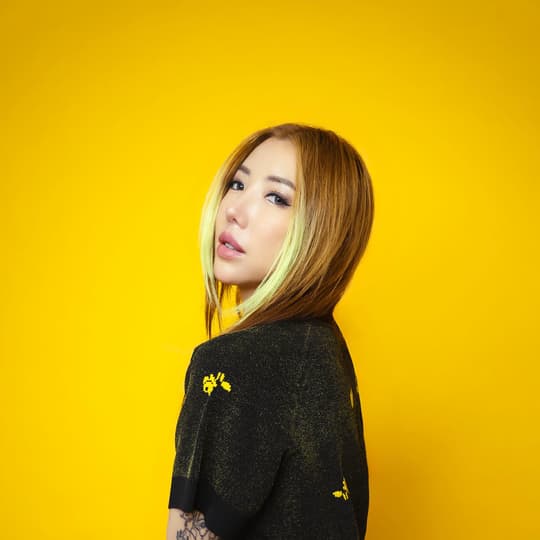
yves02: "Taking The Pressure Off Gives You More Freedom"
yves02 explores the process of breaking away from expectation, finding your own artistic identity, and prioritising what you want to say over what you think people want to hear on his latest album, '12 stars'.
The London-based artist, who began making music while studying in Nottingham, first gained traction through his hidingthehurt project, which brought opportunities to perform outside the city and established a growing audience around his sound. As expectations around the project grew, he began to feel increasingly constrained by what people expected him to make, eventually beginning yves02 as a new creative outlet alongside it. The project has allowed him to take the pressure off and create more freely on his own terms.
Written in the small pockets of time between work and everyday life, '12 stars' reflects this shift, bringing together spoken-word passages, extended tracks and moments of stripped-back instrumentation across a record that moves freely between genres. Influenced by the likes of Sun Kil Moon and the emo rap that first inspired him to make music, the album takes a more introspective approach, giving yves02 space to explore ideas at his own pace and prioritise what he wants to say over what he thinks people want to hear.
To mark the release of '12 stars', DMY sat down with yves02 to talk about developing the new moniker alongside hidingthehurt, the decision to surprise release the album, his influences and unusual recording rituals, as well as finding the confidence to create for himself rather than an audience.

You’ve wound down your hidingthehurt project in recent years, with this album being released under your other moniker, yves02. How do you feel about both hidingthehurt and yves02 at this stage in time?
yves02 is my priority. But I like having both of them, really, so I can drop different types of music. It used to be uncommon to have multiple projects, but now I’ve seen an influx of people having archive accounts or secondary pages, which I think is really interesting. I’m using them in tandem. hidingthehurt was my main one for a while, but the music I’m releasing now is different to what I was doing back then. Over time, you build up an image, or a mood, or a genre, and it’s hard algorithmically as you get put into a box. So, it’s nice to be able to break out of that.
Taking the pressure off it was really important for me. hidingthehurt got to a decent level when I was at university - I was playing shows outside of Nottingham, and balancing law school with that is pretty impossible. You have to go all in these days to make it work. I found it hard to balance studying and music at the same time, which is part of the reason I’m putting the album out with no singles and no real rollout. Taking the pressure off gives you more freedom.
Releasing an album with no rollout or singles is a bold approach. What is it about that approach that appeals to you? And do you think there are any benefits for the listener too?
For me, the benefit is that I don’t dwell on it too much. When I did my first EP in April 2022, I released a single in October 2021, and I started to question my decisions and wanted to rework the whole thing. A surprise drop, all in one, allows me to not overthink it as much. I don’t have any reservations about the album, which has been a big part of me not releasing music. I had a whole album ready earlier this year, but I scrapped it because I sat on it for too long.
The benefit for other people is that they’ll discover the album as a whole and be forced to listen to the variety of genres and experimental sounds I’m portraying. If they discover a single, they might not like it and not check out the rest. If they listen to the whole album, they can go to the next song and maybe they’ll like that one. Trying too hard to market it or have a certain rollout is not really the style of the album, or of me.
I can hear you pulling from everything you’ve done to date, with some new things too. It feels like you’re operating in your own lane now. How would you describe that journey?
Taking a break from it all was the main thing for me. When I gained traction in 2020 or 2021, that meant more opportunity. I was 18 or 19 then, at university, making money from music on the side. But you start to equate that with what you have to make. You think, this is making me money, so people like it, but if I make something else, I might lose the money or the listeners. If you want to make art that’s true to yourself, you have to try and remove those elements of corporatism, so I think that’s been the main thing for me.
Going into this album, what influences did you have in mind?
It’s funny because it changes depending on the project, really. I used to focus on stylistic choices. If someone was singing about something specific, you think, I should write about that too. Or if you hear an instrumental, you try to produce like that. With this one, I was listening to a lot of Sun Kil Moon, the other alias of Mark Kozalek from Red House Painters. He released a tonne of solo albums. Some of his songs are literally 10 minutes long, just him with a guitar and maybe a bit of harmonica or bass, just talking about his life. It’s so simple but so effective. Equally though, I listen to a lot of modern electronically adjacent music, so bridging the gap between those two different styles was something I wanted to attempt.
The main thing though for me is that I want to be able to say something important. I found that taking a step back and putting that first, over image or instrumental, was important for me. There are a handful of songs on the album that are over five minutes long. It’s the first time I prioritised what I want to say over what I want to hear. I used to write a song at the time of making it, so there’d be no gap between the words and recording. For the first time, I wrote at random, such as on the tube or on my lunch break. The gap between writing and recording was a different approach for me.
The songs don’t feel too long or like they’re overstaying their welcome, due to their unconventional structures. With songs getting shorter, do you feel there’s still an appetite for longer tracks?
People’s attention spans are worse, and this is me trying to find the right people who still have them. There are songs on there that are under two minutes because I still think you need the variation. I don’t think the songs feel too long, which is a good thing. If people don’t want to sit through five minutes, that’s okay. But there will be people who do.

The album is titled ‘12 stars’. Where did that title come from, and when in the process did you decide on it?
The meaning itself is quite abstract and personal, so I like not explaining it too much. But the idea for the name came first, and then it inspired the themes of the record and the lyrical content. The album title was decided first, and then that became indicative of the album as a whole, really.
There are regular spoken-word samples across the album, on tracks such as ‘worthy’, ‘best friends’ and ‘nil nisi optimum’, which reminded me of late-2010s emo rap like Convolk or nothing,nowhere. Did you draw inspiration from that genre?
That’s bringing it back to the start. Without that genre, I wouldn’t have started making music in the first place. Convolk, guccihighwaters... I guess you could say, down the line, it’s influenced how I made music, because that’s what first influenced me. The vocal samples don’t come from the emo rap scene itself, but it definitely influences a large portion of the album, particularly the lyrical content. I wouldn’t say the delivery, because it’s not rap. The samples are more there to give ambience. There’s a spoken-word part that I recorded at the end of ‘headache’, which is one and a half minutes long. That came from wanting to prioritise a message but feeling like I can’t do it all through singing.
I wanted to talk about ‘headache’ as I feel like it works as the centrepiece of the album. It’s a song of two halves, with the spoken-word section at the end. What was the process of recording that?
I was in the studio with a friend, and we were having a conversation. I thought I could just roll the mic while we were talking. I get nervous leaving a song unmixed, because I get paranoid that my laptop is going to crash and I’ll lose the file. So, I needed to mix it so I could send it to the cloud and relax. It’s the first album I’ve fully recorded in the studio rather than at home, which was a different experience for me.
You talk about disconnecting from the numbers and making music for yourself rather than for anyone else. What was that process like for you, and what would you recommend to other artists?
I think it came with maturity. I was 18 when I first saw the numbers, and now I’m 24. The main thing was exposing myself to more of the industry in general. The landscape has changed now. Playlisting was a major thing, but now that’s not really the case. I knew my music would get playlisted if I made a certain sound, and then I’d get streams. But it didn’t actually fulfil me.
It became more about wanting to have 1,000 genuine fans rather than 40,000 passive listeners. You need to try and create some kind of artistic direction for yourself and have in mind what you want to embody. That doesn’t have to be a genre. I used to think it did, but it’s more about making it uniquely yourself. Say things that are real, not what you think people want to hear, and stick at it.
It takes longer to break through now, and it’s more difficult than when I started in lockdown. The landscape has changed, so you have to persevere through it. But that perseverance comes from understanding what you want to embody as an artist. That direction will carry you through the long time it will take.
You previously self-produced a lot of music. Was it the same here, even though you were in the studio rather than your bedroom?
The production was outsourced to people I know, and then I would add elements in myself. So, I didn’t work in person with any producers. I actually had some weird rituals while making the album. I made the whole thing in jogging bottoms and a white T-shirt, and I took all my jewellery off. I thought, if I was trying to say an important message, I didn’t want materialism around me.
No one else was allowed in while I was recording because I didn’t want them to disrupt my flow. If other people are suggesting lyrical content, it’s not my own thoughts anymore, and I don’t want that. Also, I was only eating plain crackers and drinking water while I was making the whole thing which sounds pretty strange, but for me if I’m evoking something introspective, I need to be in a state of mind where I can’t feel anything luxurious or high-end.
What’s your own personal favourite track on the album?
The last song, ‘dust’, is the most special to me. It’s the first one I made that was aimed at someone, so writing that was a big process for me. I’m a perfectionist, but I’m also a realist and I understand that roughness in a mix for example isn’t something to feel negative towards. On that one, though, I was determined to get it perfectly done to the best of my ability. The meaning of it warranted that attitude, for me.
In most sessions, I’d make two songs in around four hours. But for that one, I extended the session and really took my time with it. It was the second song I made for the album, and to me, that’s the most personal one. It’s my highlight because it means the most to me, even though it might not be the most commercial or interesting-sounding.
What do you see in the future for both hidingthehurt and yves02?
It depends on the reception to the album, which will be assessed over a while. I have hopes that it will garner a small following. I’m surprise releasing it, but I want to get it in the right places. I’m also working on adapting it to be played live, as I haven’t played live in years, and I think these songs would be good to play to an audience. I’d love to press it onto vinyl, too. It’s not a commercial album, but I think it could grow over time if it gets to the right people.